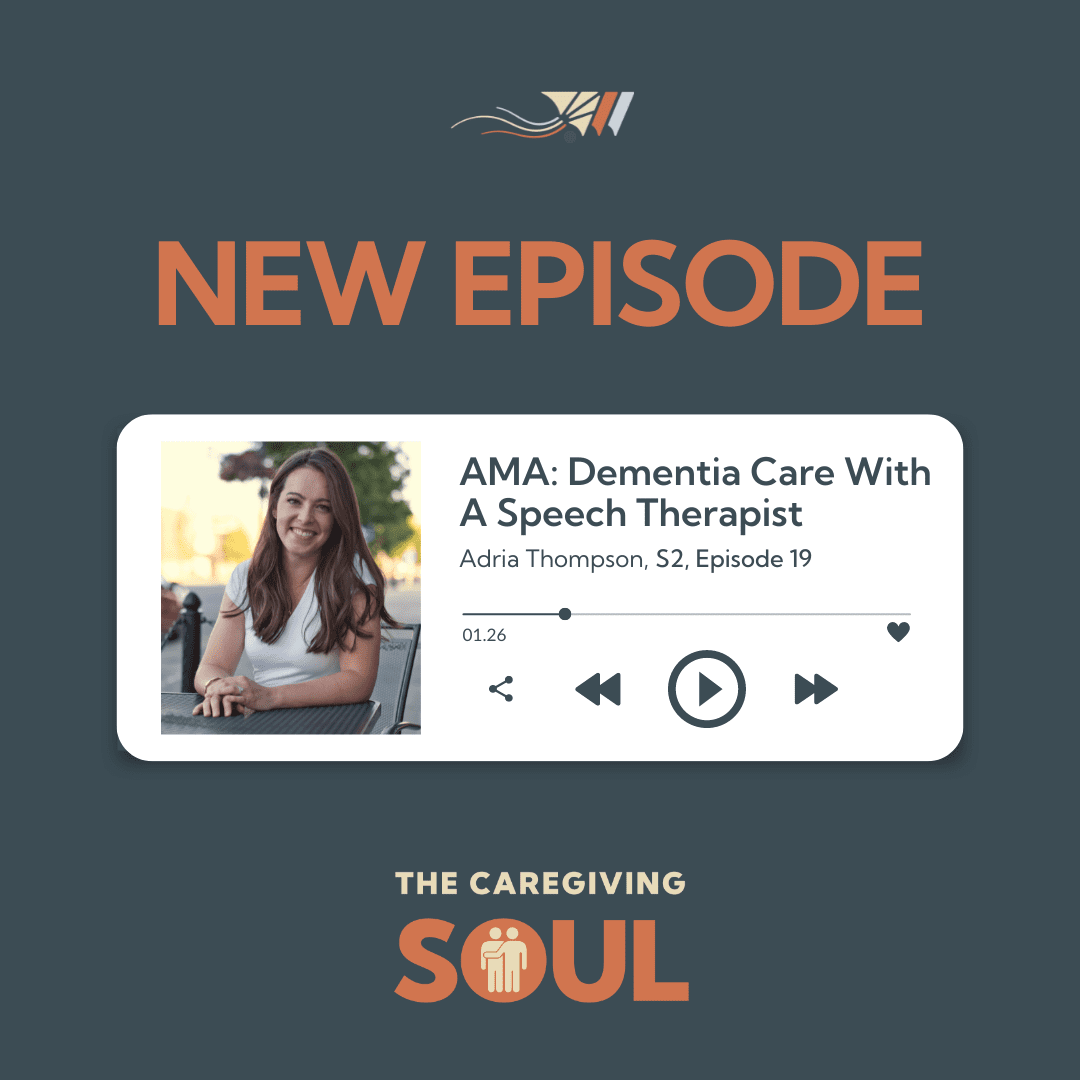




Caring for a loved one going through brain change can be overwhelming, with daily tasks often met with difficulty and frustration. In our very first “Ask Me Anything (AMA)” episode, Speech language pathologist and dementia educator, Adria Thompson, shares the importance of focusing on what brings joy and purpose to our loved ones, making daily tasks more meaningful and motivating for them. With her extensive experience, Adria has shared a number of ways to lean into their interests and passions, personalizing the approach to their unique needs.
Resources
- Helpful Tips for Showering
- Towel warmer for bath towels
- Transfer bench
- An example of a security pole for the bathroom
- Our episode with Carl Hirschmann – A deep dive into technology that is very helpful for caregiving
Guest Links
- Website: Be Light Care Consulting
- TikTok: @belightcare
- Instagram: @belightcare
- Facebook: @BeLightCare
About Adria Thompson

Adria Thompson is a speech language pathologist and dementia educator who runs her own practice – Be Light Care Consulting. With 9 years of experience in dementia care, she creates practical and educational content for 265, 000 professional and personal caregivers on social media platforms. She also offers one-on-one speech therapy services, caregiver consultations, creates continuing education courses, and works with senior care companies and brands. In 2018, she and an occupational therapist created a program to train other therapists in how to provide more effective treatment with improved outcomes with individuals with dementia that has now been taught in 14 states and over 150 care communities. Adria is passionate about increasing public awareness of dementia and educating others on the importance of quality care.
Transcript
[00:00:00] [Music]
[00:00:03] Adria: When it comes to dementia, we’re not getting someone back to how they were before. It’s a degenerative disease, which means it gets worse over time. And so, the model that we do in speech therapy here is more of a habilitative model, which is basically keeping someone as independent as possible.
Read More
[00:00:23] Dannelle: Caring for a loved one going through brain change is such a roller coaster of the unexpected. Finding creative ways to manage stress is often time consuming and exhausting. We may find ourselves sifting through resource after resource. Our guest today offers some workable ideas.
[00:00:49] Adria Thompson is a speech language pathologist and dementia educator who has spent her career helping individuals with dementia to maximize their communication abilities and quality of life, while also supporting their loved ones through the caregiving journey. She shares her expertise on social media by focusing on tips to simplify dementia care with practical products and technology, as well as general dementia care information.
[00:01:25] Welcome to The Caregiving Soul! I’m Dannelle LeBlanc.
[00:01:32] [Music Ends]
[00:01:32] Adria: So, a speech language pathologist and a speech therapist is the same thing, so we help people in three main areas, communication, swallowing, and cognition. And so, communication is most easiest understood as being able to be understood when you speak, right? But we also provide treatment for children, and I received speech therapy when I was younger because I had articulation issues.
[00:02:00] And so, that’s a lot of times what we think about when we think of speech therapy. And that’s accurate for a lot of populations. That is the majority of what we do, is to help someone be understood when they speak. But that’s just a very small percentage, especially in the medical field of what we do.
[00:02:17] So, communication isn’t just about expressing yourself and being understood, but it’s understanding others when they speak. So, comprehension of communication is really important, and we help people with that too.
[00:02:30] Then a swallowing disorder, the medical term is called dysphagia, and this is basically any problems from where food or drink passes the lips and to where it empties into the stomach. If there’s any issues, someone getting choked or what we might describe as going down the wrong way. Maybe someone who pockets food, which just means they keep it in their cheeks, or maybe they have a hard time chewing it and getting it down. All of those things we assess, we diagnose, and we treat.
[00:03:01] And then cognition is just basically a term for thinking. So, that obviously includes memory when it comes to people with dementia. We can assess and treat memory issues, but we can also help with problem solving, safety awareness, planning, thought organization, attention.
[00:03:21] Now we help people with cognition across all of these things – communication, swallowing, and cognition – from birth until death, like every age group, every demographic we can help in all areas, in every setting you can possibly imagine. Speech therapists are there. But when it comes to individuals with dementia, our role isn’t necessarily the classic rehabilitation model, which is basically where we wanna restore abilities that are lost because of an illness, injury, or condition.
[00:03:57] So, much like a physical therapist can rehabilitate a broken leg so that you can get back to exactly how you were before, when it comes to dementia, we’re not getting someone back to how they were before. It’s a degenerative disease, which means it gets worse over time. And so, the model that we do in speech therapy here is more of a habilitative model, which is basically keeping someone as independent as possible. So just maintaining their skills a little longer than maybe otherwise.
[00:04:27] Dannelle: Okay, so, I wanna dig into how you help people. And so, we thought that it would be a great idea, on the Empowered Us TikTok channel Technically Sick, you and other social media influencers share simple tech hacks that support day-to-day living for people who have a chronic illness or disability, which I think is wonderful because sometimes we just, we don’t know where to start, where to look for help.
[00:05:01] And we had three previous guests of The Caregiving Soul write or call in with certain challenges that they faced while caring for their loved one. And so, I’d love to, in real time, get some tips and suggestions from you to help navigate each of these scenarios. How does that sound?
[00:05:24] Adria: Yeah, I love that. Let’s do it.
[00:05:27] Dannelle: A previous guest, Kris McCabe, called in with her question.
[00:05:27] [Music]
[00:05:34] Kris: Over the last six years as my grandma’s caregiver, we have definitely struggled with eating. I feel like every few months there is some sort of eating change, and we constantly have to try to figure out what is going on.
[00:05:47] There have been many times I would set the plate up like I always do, and my grandma would refuse food. There were many issues. Sometimes it was her stomach, constipation, her dentures. Maybe it was just overstimulating. Maybe we weren’t in a comfortable setting.
[00:06:04] It can be very frustrating, and you can feel like you don’t know what’s going on because one day they’ll eat and the next day they won’t, and they don’t have the ability to tell you what’s bothering them. So, it’s always like a guessing game, and it can be so frustrating and so disheartening.
[00:06:20] In these later stages, I feel my grandma has a fear of food. Now it’s less about the atmosphere or what is on the plate, it’s more of the fear of choking or not wanting to eat as much. So, ooh, when it comes to food and Alzheimer’s, dementia, it is difficult.
[00:06:41] Adria: I really love Kris. This is a great question, and this is a big concern for a lot of caregivers, especially when it comes to eating. It can feel like a really big deal because eating is necessary for all of us to survive. And so, the first thing I wanna say is swallowing issues at the end of life in general, but also for people with dementia are pretty common.
[00:07:04] And so, as a speech language pathologist, I couldn’t answer this question without saying that if you have someone that you love that is demonstrating swallowing difficulties to get a referral from a doctor for a speech language pathologist to assess that person so they can give individualized recommendations. That is extremely important to make sure that they stay safe.
[00:07:27] Beyond that, when it comes to getting someone with dementia to do something that we think is really necessary and they feel as if it’s not, they don’t want to do it, that’s where the most frustration comes into caregiving. So, we have to think about why these things are happening and Kris gave a really good insight into some of the reasons, right? So, overstimulation, fear of swallowing, and also just not being motivated to. So, some recommendations that I would have for Kris is to think about in what situations does her grandmother seem motivated to eat?
[00:08:12] And I’ll give an example. I had a patient once who was very motivated to eat fast food. She loved fast food. It was always a treat for her growing up, and she, when she saw that bag and the logo on it, she was just, she didn’t care what was in it, she would eat it. And the family was having a hard time thinking we cannot bring food to her every single day. It just wasn’t practical. Financially it can be difficult for a lot of families, and so what we started doing was we went to her favorite fast-food restaurant, and we got lots of bags and packaging and wrappers, and we started packaging all the food that we made for her in those containers.
[00:08:57] And so, as far as she knew it was being presented to her in a very motivational way, a way that made her excited about eating. And so, for someone who has a neurological disease that can’t reason that, well, it’s been two days since I ate a good meal and I really need to, even though I don’t have the appetite too, that’s really complex. But if we can set something in front of them that is like, Ooh, I want that. Then we can put anything, a ham sandwich [Laughs] in a bag. And as long as it’s packaged well, it could be motivating.
[00:09:31] And I also really like the idea of using technology to decrease stimulation or increase stimulation around them. So, maybe watching shows about food right before we eat, that can start to increase appetite. I know I was watching a cooking show on the plane the other day and I was like so hungry. That can increase our appetite. Make them see what might be coming next.
[00:09:58] We might wanna make the background seem like a restaurant. Have some ambiance music, set them up well with a nice wine glass and utensils. Things that make them key into like, this is what’s happening now. I’m eating, and this is expected. Rather than just throwing some food in front of them on the couch, that might not facilitate understanding of the situation as well.
[00:10:25] Dannelle: That is so smart. I love the idea of packaging the food in the fast-food wrappers. Oh my gosh, that is –
[00:10:39] Adria: It works.
[00:10:38] Dannelle: – so smart.
[00:10:39] Adria: Mm-hmm.
[00:10:40] Dannelle: Holy cow. And also, the idea of queuing someone up so they know what to expect, creating a familiar environment that is associated with eating prior to a meal being presented is a really great tip.
[00:11:00] Adria: Yeah, there are some things that we take for granted that are required to make us want to eat. Sometimes our hunger just makes us feel that way, but a lot of times it’s knowing what time of day it is, and that’s our motivation for eating. Cuz we’re like, well, I may not be hungry right now, but dinner will be in like four hours, and I should probably eat now, or I’m gonna not be hungry later.
[00:11:22] So, knowing what time of day it is even just informs our ability to know if we’re going to eat or not. And for someone with dementia, they don’t always have that awareness or the memory of the last time they ate. They might have thought that they ate five minutes ago when really it was yesterday. So, we take it for granted the things that go into the decisions we make.
[00:11:42] Dannelle: Yeah, it’s hard cuz we have to think about and approach things so differently. And I’m gonna throw in one more tip, related to eating. And that is using an appetite stimulating essential oil like cinnamon, to help stimulate the salivary glands and again, to queue up and prepare someone to want to eat.
[00:12:12] Adria: Yes, aromas can literally make your mouth water, which then gets you ready to eat. That’s good.
[00:12:19] Dannelle: Okay. This one is a letter from Patti LaFleur. She writes, [Music] “My mom hated shower day. She would often tell me she didn’t need one, or that she was scared. I would do everything possible to make her more comfortable – heater, music, warm towels, and even a stuffed dog. But she still was not convinced she would want to shower.” [Music Ends] Okay Adria, what do we do?
[00:12:52] Adria: Showering is one of the most often refused parts of care. It is a very big issue for caregivers to get someone to shower. I also love Patti, I got to meet her last year. She’s really sweet and did such a good job with her mom.
[00:13:10] As a caregiver what we have to do when it comes to especially showering, is we need to be aware of the actual objection that they have and address it head on. This can be difficult if someone with dementia doesn’t have the ability to communicate exactly what’s going on.
[00:13:29] So, for example, she mentioned how she used heater and warm towels. That is a great, what we call intervention for someone who’s reason for not showering is because they’re cold. But if that’s not the reason that someone doesn’t wanna shower, that might not necessarily meet their need.
[00:13:51] So, if Patti’s mom was scared, which many people are, there could be a couple of reasons for that. First, it could be she was going to be scared that she was going to fall, and fear of falling can often be helped by using pieces of equipment that will ensure someone’s safety.
[00:14:13] So, I really love using transfer benches. And a transfer bench is basically a shower bench that extends outside of a traditional tub. So, someone can sit on the bench and then swing their legs into the tub over the lip. This kind of device keeps people from being fearful of standing and stepping into the tub. We can also use things like transfer, or what we call security poles, which are just poles that they can hold onto that are often held there by tension, so they can hold onto it while they step in.
[00:14:50] But the biggest thing we can do to make someone feel safe, and I’m gonna do this to you, and I know our listeners won’t be able to see me, but I’m gonna look you right in the eye and say, you are safe. You are safe with me. I will not let anything bad happen to you. And the power of those words can really make a big difference. And we have to just sometimes take a beat to look them in the eyes and tell them that they are safe and that everything’s okay. You’re not gonna let them fall.
[00:15:26] Sometimes people are scared of showering because they have sensory issues, vision changes with dementia, and they have a difficult time seeing contrast, seeing depth perception. And so, when we pull them up, stand them in front of a white shower with clear water and a white knob, a white pole they have to hold onto and sit on a white bench, it can feel as if they’re almost floating in space. So, creating some contrast, helping them understand where one thing starts and the other begins.
[00:16:05] Warning them before we touch them. Warning them before the water touches them. Those things can help too. And creating a really good environment, like Patti said, could be the key to getting someone agreeable to showering, making it warm, playing some music, making it smell good, and kind of creating a spa-like environment can be really, really helpful.
[00:16:30] But one thing that I want to let our listeners think about is the idea that everything someone with dementia does makes sense to them, and that can be a really powerful concept to wrap our heads around. Instead of always fighting against the fact that her mom thinks she’s already had one, we can think about, well, what would make us shower if we’ve already had one?
[00:16:55] And one example of that that I used in long-term care was a gentleman who left to his own devices would go months without showering. He always thought he had already taken one and he was really aggressive when we would try to push the issue at all with him. So, one way that I thought about why my husband showers more than once a day is when he gets a haircut, he hates the feeling of hair on his neck. And so, he will always shower after he gets his haircut.
[00:17:28] So, I had this hunch and I had this man sit down in a chair in his bathroom and I purposefully did not put a drape over him. And we trimmed his beard, and it was during covid, so everyone had really long hair. We trimmed his hair and I purposefully left little pieces of white hair all over his skin and his clothes, and afterwards I said, “Oh, no. I am so sorry. Look at this. We have hair everywhere. That’s gonna make you so uncomfortable. Here, let me wash this off. We’ll rinse this off real quick. Jump in the shower and I can help you”. And he did not put up a fight at all because it was very functional in that moment that he needed to get rinsed off.
[00:18:13] And so, if we can think about the people that we love and that we’re caring for and think about in what situation would they be motivated to do the thing we want them to do, we can come up with some creative solutions.
[00:18:27] Dannelle: So creative. I love your approach of suggesting that how we can think about in what scenario would it make sense to do x, y, z, for, from the perspective and the reality of the person that we are caring for. That is a great way to think about and come up with the solution. Cuz if we’re trying to do it from our own logic, we are gonna get stuck. [Laughs]
[00:18:59] Adria: Yeah. And we’re gonna get stuck in that repetitive cycle of trying to convince them, to reason with them.
[00:19:06] Dannelle: Yes!
[00:19:06] Adria: “No list- Let me explain it to you though!”
[00:19:09] Dannelle: Yes.
[00:19:09] Adria: We think if we can just find the right words to explain to them what’s really going on, that they’re gonna be agreeable when that’s not the reality they live in.
[00:19:19] Dannelle: I don’t know if all speech pathologists are as well informed and insightful as you are, this is so much more than I would have ever considered. To get this kind of help from a speech pathologist is so helpful.
[00:19:39] And I will tell you, nobody suggested to me that I take my father-in-law to get a referral for a speech therapist. And he had Parkinson’s. And not only did he have the, the speech issues, but he had dysphagia. No one at any point recommended a speech therapist. So, I think that is a critical point that you make, that we as caregivers be informed to know to ask for one.
[00:20:10] Adria: Absolutely, and although that makes me so sad to hear that no one referred you to a speech therapist, it does not surprise me unfortunately. We are just not well understood, speech therapists, but also occupational and physical therapists can offer a lot of support in education and training for individuals with any condition, but especially dementia.
[00:20:34] And we are not referred to enough because too many people think, well they have dementia, they’re not gonna get better. So, what’s the point? I’m not here to make anybody better, but I can make caregiving easier, and that’s huge.
[00:20:52] Dannelle: It is huge. And like you described earlier, the model that you’re working with is a habilitative model, not a rehabilitative model, but to extend and increase quality of life for both the person we’re caring for and caregivers as much as possible. And that is the habilitative model, and I think that is a key point.
[00:21:18] Adria: Exactly. Yes, I’m glad that you caught onto that, and I think that is extremely important.
[00:21:25] Dannelle: Yes. Okay, so our last letter is from LeAnn Specht. She writes, [Music] “My husband Jeff, who has early onset Alzheimer’s, has an aversion to getting dressed. He has a lifelong habit of sleeping in his underwear. Only so often he gets up in the morning and it will take me an hour or more to convince him to get dressed. I hold out each piece of clothing so he can take them from me and verbally give him commands such as step into these pants, [Laughs] or let’s sit down and put these on. And I often have to leave the room over and over again until he warms up to the idea. Help!” [Music Ends] Adria, how can we help LeAnn?
[00:22:21] Adria: Let’s pose the question we did earlier, in what situation might he be agreeable to getting his pants on? Now I also know LeAnn and met her in person. She’s wonderful and a very creative caregiver for her husband. So, one thing this makes me think of is, one time I had a patient who was extremely well dressed.
[00:22:46] It was very important for her to look nice, but she got in a groove where everything in her closet she didn’t like anymore. She was just resistive to putting on anything. She thought she had just worn every piece of clothing, and I know what that feels like. [Laughs] I’ve been there too, right? Where you just stand in your closet and you’re like, I’ve worn all of these pieces a thousand times.
[00:23:10] But one thing that I did, thinking about what motivates her and in what situation she was motivated to put on clothing, was I got a JCPenney bag, I got a shopping bag, and I folded up clothes that she already had in her closet very nicely, and we would put it down in the bag.
[00:23:32] I would walk out of her room and then I would knock on the door and come back in and say, “Ruth, look, your daughter dropped something off for you. There’s this beautiful pair of pants, but I dunno if they’re gonna fit. I know you have, you look so nice and thin and fit. I, these might be too big. Let’s slip them on real quick and see if they fit”.
[00:23:57] And like clockwork, every day she would put on those pants because she loved shopping. She loved getting new things, and so I tapped into what was motivating for her and she would put them on, and she’d be like, “Well, these fit like a glove”. And I’m like, “Oh my goodness, this is perfect. Let’s find a top that goes with these new pants”.
[00:24:21] And then it became much more fun rather than, “Ruth, you have to put on something. Come on, you haven’t worn these. It’s been weeks”. That fight is never a fun one, and it’s never one that we win. But if we can make the getting dressed experience fun for someone, then why the heck not?
[00:24:45] And so, it makes me think maybe if we presented him with some pants that he thought were new or a gift from someone where we are very often, once again, what are the situations in which I put on clothes multiple times a day? When I’m trying something on to see if it fits. And so, we can ask let’s put these on real quick, see if they fit, and if so, we’ll give your granddaughter a call and tell her thank you. But thinking about those kind of things and how we can kind of replicate those moments can give us a lot of success.
[00:25:25] Dannelle: So, what this is making me think of, Adria, is, so first of all, how you described LeAnn and the other caregivers being so creative in caregiving. And I think that in particular, when we’re caring for someone with brain change, that creativity is, is a huge, huge help. And what it does is it, we’re really tapping into a childlike approach.
[00:26:00] And one of the barriers for many people I think, in doing that is, is that we don’t wanna feel like we’re lying to someone and so I would suggest that we reframe that. We’re approaching this with a childlike play and creativity and to get past that barrier of we want to be honest, we wanna be truthful, that we can be honest and truthful in the context of our person’s reality and what’s important to them.
[00:26:39] Adria: Yeah, and I respect that when I hear caregivers say, I don’t want to lie, or I don’t feel comfortable saying anything than the truth. And I, I respect that, like I said. But I do know that we need to take a realistic step back and think, well, how is the truth working out for us? You know, how is that working and how is it creating unnecessary friction in our lives?
[00:27:08] Dannelle: And who’s truth is it?
[00:27:10] Adria: Right. Because the reality that they live in, it might be 1973, they think that they are 35 years old and that they just played baseball and went to the bar last night, and then some woman’s coming in and telling them to put on their pants. It is a –
[00:27:31] Dannelle: [Laughs]
[00:27:31] Adria: – world that doesn’t make sense to them, right? In their world, you are lying. And so, it throws everything upside down. And I like to think of it as empathy, right? We are looking at the world through their eyes. We’re trying to understand what struggles they’re experiencing, the stress that they feel, and we’re trying to make things easier for them.
[00:27:56] We just need to lead with love and be creative. If we take this creative approach, it takes caregiving from this arm wrestle, or like whole body wrestle it feels like some days, to an art form almost. And I think the quality of life and the freedom that kind of comes for caregivers mentally when we shift our perspective is as important as getting the care tasks done.
[00:28:27] Dannelle: Absolutely. The barometer is – how does it make them feel?
[00:28:32] Adria: Yeah.
[00:28:33] Dannelle: We have another question, related to technology specifically, because it can be so daunting both for people with brain change as well as for us as caregivers. So, how do you use your platform to better integrate technology and source effective resources for people living with dementia?
[00:28:57] Adria: There’s so much new technology that exists right now in the caregiving space that can make caregiving easier. And it’s hard when we think about technology and caregiving, especially when it comes to dementia, because many of the people who have dementia are over the age of 65, and they didn’t grow up with a lot of technology, much less the kind of technology that we have right now.
[00:29:19] So, we assume that it doesn’t apply to them. But even if someone with dementia cannot independently use a piece of technology, doesn’t mean that they can’t benefit from it. Sometimes we have to modify things. We might have to simplify things. I have videos on my page about how we can basically erase a million apps on people’s phones. We can change the background, we can use shortcuts. We can make things more salient and stand out more, the things that are important. Same things for desktop computers and things like that.
[00:30:02] But modifications can really allow people with dementia to access technology, but also as caregivers, we can use it to provide supervision. There are pieces of technology that’s of course, like not even just the traditional surveillance systems where we can like video watch somebody, but there are now sensors that can change people, videos of people into stick figures to, to preserve their dignity and to keep us from watching them naked getting in the shower. I mean, it’s just incredible what exists out there.
[00:30:38] And I’ll say for technology too, I am a piece of caregiving support that exists on technology. I create 30 to 90 second videos of easily digestible, very practical tips and tricks and pieces of information that will make caregiving easier. All you need is social media to watch my videos.
[00:30:59] And so, technology is opening up the world to caregivers of individuals with dementia, especially because they’re typically so isolated. And so, there’s a lot of community to be built, but a lot of information to sift through. And I know it can feel overwhelming sometimes. So, that’s why I focus my advice and tips in such short formats. You don’t have a lot of time as a caregiver.
[00:31:28] Dannelle: Ain’t that the truth?
[00:31:30] Adria: Mhmm.
[00:31:30] Dannelle: [Laughs] It can feel really overwhelming, and we know that not every tip is going to work for everyone. And so being able to quickly access to see, oh, you know what, I could use this. Oh, you know what, that doesn’t quite fit my situation. Adria, this is so good.
[00:31:51] Adria: Thank you. This is my passion in life. I think you probably can feel it talking to me that I just love talking about dementia, about caregiving, and about being creative. It is absolutely what I’m meant to do. This maximizes all of my strengths and I just am so honored to be a part of so many people’s dementia journeys, and I would love to be a part of more so find me!
[00:32:17] Dannelle: Ah, so lovely to meet you and to learn so much from you in such a short period of time, and I look forward to learning more. Thank you so much for joining us on The Caregiving Soul, Adria.
[00:32:32] Adria: Thank you so much for having me. [Music] This was a lot of fun.
[00:32:39] Dannelle: Thank you for joining our conversation with Adria.
[00:32:44] Adria highlights the importance of focusing on what brings joy and purpose as a way to make daily tasks more meaningful and motivating. She shares a number of ways to leverage our loved one’s interests and preferences to personalize how we approach care, especially in situations where we expect conflict.
[00:33:13] Adria highlights the importance of focusing on what brings joy and purpose as a way to make daily tasks more meaningful and motivating. She shares a number of ways to leverage our loved one’s interests and preferences to personalize how we approach care, especially in situations where we expect conflict.
[00:33:41] Adria has emphasized the potential value of technology to help support caregiving. We have links to the tools mentioned in this episode in our show notes, but I recommend following Technically Sick on TikTok. There you can find a variety of advocates highlighting their favorite technology and products that support those living with chronic illness or disability.
[00:34:10] Check out our show notes to connect with and follow Adria.
[00:34:15] Every episode of The Caregiving Soul has a page on empoweredus.org where you can find the extended show notes, including tips and takeaways, transcripts, and relevant resource links.
[00:34:28] For additional bonus content from this episode, and to connect with us, be sure to follow the Empowered Us social channels on Instagram @empoweredusnetwork and Twitter @empowereduspod.
[00:34:44] The Caregiving Soul is an Empowered Us original, presented by Good Days, hosted by me, Dannelle LeBlanc. If you liked this episode, be sure to rate and subscribe to the show wherever you get your podcasts.
[00:35:02] And remember, the right care includes care for you.
[00:35:10] [Music Ends]
Read Less
Recommended this Week

How to care for people with neurological diseases by putting the relationship first and speaking their “language”.

How to celebrate caregivers and navigate caregiving as a young adult.